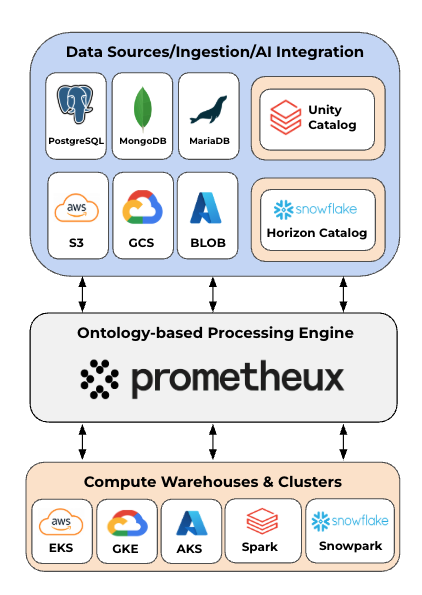
This walkthrough builds your first Prometheux project from scratch. You will start from a handful of facts, model a simple business rule, and end with a small executable ontology that reasons recursively over your data. If you have not installed Prometheux yet, start with Installation and choose the environment that fits your team (Cloud, Snowflake, Databricks, or on-premises).

What you are building

In Prometheux, an ontology is not just documentation — it is a runnable model that defines entities, relationships, and the logic used to query and process data. You write that logic in Vadalog, a declarative language. For this first project, we will answer a classic question about company ownership:
A company X controls a company Y if:
  1. X directly owns more than 50% of Y; or
  2. X controls a set of companies that jointly — possibly together with X itself — own more than 50% of Y.
We will model this with the conglomerate Yum! Brands and its holdings (KFC, Pizza Hut, and others), then let Prometheux compute every company Yum! controls, directly or indirectly.

Declare what you want, not how to get it

Unlike traditional data processing, you do not write Vadalog as imperative steps (“first fetch this, then join that”). Instead, you declare what the output should be and let the engine do the work. For example, deciding whether a user is “engaged” (10+ events in the past 30 days) looks like this declaratively:
eventsCountSince(UserId, SinceTime, Count) <-
  event(EventId, UserId, Timestamp),
  Timestamp > SinceTime,
  Count = mcount(EventId).

isEngaged(UserId) <-
  eventsCountSince(UserId, now() - 30 * 24 * 60 * 60, Count),
  Count > 10.
Someone who does not write code can still read this and reason about what it does. That readability is a core goal of modelling with ontologies.
New to the language? Skim Thinking in Vadalog and the Vadalog overview first. This page assumes only a general sense of the syntax — it should be easy enough to follow along.

Step 1 — Start with facts

Facts are ground truths that will eventually come from your data sources. For now, write them by hand so you can run the program immediately.
owns("Yum", "KFC", 0.6).
owns("Yum", "Pizza Hut", 0.7).
Each owns fact reads: an owner holds a fraction of shares in a brand.

Step 2 — Model the first business rule

Rule 1 says a conglomerate controls a brand when it directly owns more than 50% of it. Think of relationships between entities as verbs — owns, controls.
owns("Yum", "KFC", 0.6).
owns("Yum", "Pizza Hut", 0.7).

% Yum! controls some brand if it owns more than 50% of the shares of that brand.
controls("Yum", SomeBrand) <- owns("Yum", SomeBrand, Shares), Shares > 0.5.
The head atom (controls(...), before <-) declares intent; the body (after <-) is the implementation detail.

Step 3 — Add indirect ownership

Real ownership is rarely direct. Introduce an intermediary: Yum! owns 70% of FastFoodsGroup, which owns 45% of McDonalds, and Yum! also owns 10% of McDonalds directly.
owns("Yum", "KFC", 0.6).
owns("Yum", "Pizza Hut", 0.7).
owns("FastFoodsGroup", "McDonalds", 0.45).
owns("Yum", "FastFoodsGroup", 0.7).
owns("Yum", "McDonalds", 0.1).
By Rule 1 alone, Yum! does not control McDonalds (only a 10% minority stake). To capture joint ownership, we sum a conglomerate’s direct and indirect shares before applying the 50% threshold. We track those shares with a helper, has_shares, and a summed total, has_total_shares.
When aggregating across recursion, use the recursion-specific aggregators (for example msum), which keep the running aggregation correct across each recursive call.

Step 4 — The complete ontology

Putting it together, generalised over any conglomerate, and exposing the result with an @output annotation:
owns("Yum", "KFC", 0.6).
owns("Yum", "Pizza Hut", 0.7).
owns("FastFoodsGroup", "McDonalds", 0.45).
owns("Yum", "FastFoodsGroup", 0.7).
owns("Yum", "McDonalds", 0.1).

% Rule 1: Conglomerate has `Shares` amount of a brand if it owns that amount of shares
% in the brand.
has_shares(Conglomerate, _, SomeBrand, Shares) <-
  owns(Conglomerate, SomeBrand, Shares).

% Rule 2: Conglomerate has `Shares` amount of a brand if it controls an intermediary
% who has that amount of shares in the brand.
has_shares(Conglomerate, Intermediary, SomeBrand, Shares) <-
  controls(Conglomerate, Intermediary),
  owns(Intermediary, SomeBrand, Shares).

% Sum all the direct and indirect shares of some brand that the conglomerate has.
has_total_shares(Conglomerate, SomeBrand, TotalShares) <-
  has_shares(Conglomerate, Intermediary, SomeBrand, Shares),
  TotalShares = msum(Shares).

% Conglomerate controls some brand if its joint ownership of that company's
% shares is above 50%.
controls(Conglomerate, SomeBrand) <-
  has_total_shares(Conglomerate, SomeBrand, Shares),
  Shares > 0.5.

@output("controls").
A couple of details worth noting:
  • The two has_shares rules must share the same arity. We force the first to four arguments with an anonymous variable _, so Prometheux treats them as two branches of one predicate rather than two separate predicates.
  • controls is recursively defined only at the level of has_shares, not as its own base case. Keeping the output to a single atom and recursing one level deeper avoids subtle bugs where indirect relationships more than one hop away go missing.

Step 5 — Run it and read the output

Running the program produces every control relationship the rules can derive:
controls("Yum", "Pizza Hut")
controls("Yum", "FastFoodsGroup")
controls("Yum", "KFC")
controls("Yum", "McDonalds")
Yum! now controls McDonalds because its direct stake (10%) plus its indirect stake via FastFoodsGroup (45%) sums to 55%, above the 50% threshold. Change one fact — say FastFoodsGroup owns only 20% of McDonalds:
owns("FastFoodsGroup", "McDonalds", 0.2).
Now the joint stake is 10% + 20% = 30%, below the threshold, and the output drops McDonalds:
controls("Yum", "Pizza Hut")
controls("Yum", "FastFoodsGroup")
controls("Yum", "KFC")

Why recursion matters

Because Rule 2 builds on controls — the very thing we are computing — the model naturally follows ownership chains of any depth. Extend the data so Yum! and McDonalds are several hops apart:
Yum -> FastFoodsGroup -> DeepFriedFoods -> McDonalds
A non-recursive version that only looks one hop deep would miss the connection. The recursive ontology above keeps following the chain until it bottoms out at the facts (the base case), so it correctly reports the indirect control. This is why thinking recursively often produces simpler, more correct rules with a single source of truth for each business rule.

Connect real data

The facts above were handwritten so you could run the program right away. To bind a predicate to a real source instead, replace facts with bindings. For example, the same logic backed by PostgreSQL tables:
@qbind("controls", "postgresql", "database", "select controller,controllee from controls").
@qbind("owns", "postgresql", "database", "select owner,owned,shares from ownership").

has_shares(Conglomerate, Intermediary, SomeBrand, Shares) <-
  controls(Conglomerate, Intermediary, IntermediateShares),
  owns(Intermediary, SomeBrand, Shares).
Multiple body predicates separated by commas are a join — you combine the rules that define each binding rather than reasoning about table joins directly. See Data Sources for the full list of connectors and binding options.

Where to go next